
Ma is The Japanese Philosophy of Empty Space
Ma is The Japanese Philosophy of Empty Space : There is a Japanese word that has no direct translation in English. It is written with a single character — 間 — and it means something like "gap," "pause," "interval," or "empty space." But those translations barely touch what the word actually contains.
The word is Ma. And once you understand it, you will never look at a room or a moment of stillness quite the same way again.
What Does Ma Actually Mean ?
In everyday Japanese, Ma (間) appears in compound words: jikan (時間, time), ningen (人間, human being), setsuma (接間, connecting room). The character itself depicts a gate or door with moonlight passing through the opening. It is the space that allows something else to happen.
In Japanese aesthetics, philosophy, and design, Ma refers to the conscious, intentional use of negative space not emptiness as an absence, but emptiness as a presence. It is the pause between musical notes that gives the melody its breath. It is the white space on a Japanese scroll painting that draws your eye to what is actually drawn. It is the deliberate gap in a garden arrangement that invites you to keep looking.
The philosopher Arata Isozaki, one of Japan's most celebrated architects, described Ma as "a pause that is full." What separates Ma from mere emptiness is intention. The space is there because it was chosen and its presence changes everything around it.
Ma in Japanese Architecture and Design
Walk into a traditional Japanese room a washitsu and you will immediately feel something that is difficult to name. The room may contain almost nothing: a low table, a single scroll on the wall, perhaps a small ceramic piece in the tokonoma alcove. The floor is tatami. The light comes in filtered through shoji paper screens.
And yet the room does not feel bare. It feels calm, ordered, and somehow complete.
That feeling is Ma at work.
Traditional Japanese architecture actively designs for Ma. Spaces are not filled to demonstrate abundance. They are kept deliberately spare so that each element can breathe, be seen, and be appreciated in full. A single branch of cherry blossom in a vase is not minimalism for minimalism's sake it is an act of focused attention. The empty space around it is what makes the branch visible.
This same principle runs through ikebana (Japanese flower arrangement), chado (the tea ceremony), bonsai, and zen garden design. In every discipline, the practitioner is as deliberate about what they leave out as about what they include.
The Nervous System Responds to Negative Space
This is not simply an aesthetic preference. There is growing evidence that visual and spatial complexity has a measurable effect on the human stress response. Research in environmental psychology has consistently shown that cluttered, visually dense spaces elevate cortisol levels and reduce perceived cognitive capacity. Conversely, spaces with clean lines, natural materials, and intentional negative space tend to activate the parasympathetic nervous system the branch responsible for rest, digestion, and recovery.
This is why hospitals with nature views have better patient outcomes. It is why open, light-filled spaces are associated with creativity and calm. And it is why stepping into a Japanese-style room or a well-designed sauna can feel like something physically releasing in the chest.
Ma is not decoration. It is a form of physiological design.
Ma and the Modern Wellness Space
The wellness industry has been circling this idea for years without always naming it. Biophilic design, slow living, wabi-sabi interiors, Scandinavian minimalism all of these movements, in their own way, are reaching toward what Japanese design has articulated for centuries through the concept of Ma.
When we talk about a "retreat" or a "sanctuary" in the home, what we are really describing is a Ma space: a place where everything unnecessary has been removed, where the materials are honest and natural, where the senses are given something specific to rest on rather than being overwhelmed.
This is increasingly rare in modern homes. Most living spaces are designed for function and storage, not for stillness. The result is that many people have no truly quiet place inside their own homes nowhere that asks nothing of them.
How Ma Shapes the Design of Every Nagomi Sauna
At Nagomi, the philosophy of Ma is not a marketing concept. It is a design constraint.
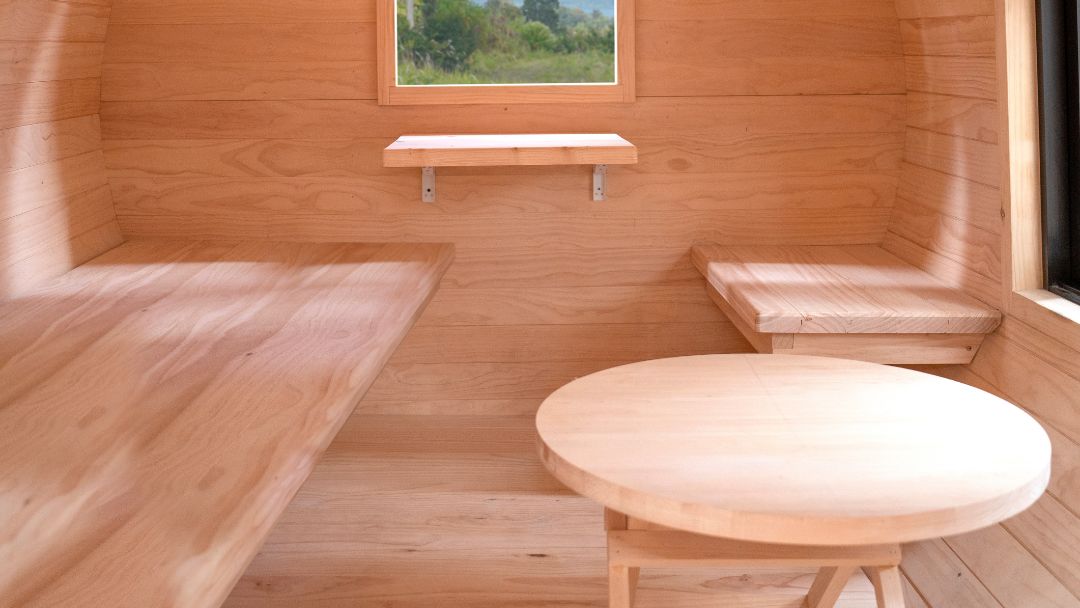
When you step inside a Nagomi Barrel or Cube sauna, you will notice what is not there. There are no ornaments, no decorative panels, no unnecessary hardware. The interior is wood Japanese Hinoki or Sugi with clean joinery, simple bench lines, and careful proportioning. The light enters at low angles. The heater is positioned to warm the air evenly without dominating the visual space. The result is a room that does only one thing: it asks you to be still.
The curved interior of the Barrel creates an acoustic softness sound does not bounce and echo as it does in a square room. The gentle arc overhead mirrors forms found in nature. There is no hard corner to catch your attention. The space flows around you.
The Cube, with its clean geometric interior, achieves the same effect through a different path. The proportions are studied. The grain of the wood runs horizontally at eye level, drawing the gaze in a direction that feels restful rather than restless.
In both designs, the empty space the Ma is as considered as any physical element. The proportions of the interior were not arrived at by accident. They reflect three decades of working with Japanese materials and Japanese aesthetic principles at our SCP facility in Indonesia.
Creating Ma in Your Own Home
You do not need a sauna to begin applying Ma in your living space. The principle is scalable and does not require expense only intention. Start with subtraction rather than addition. Before buying anything new, consider what could be removed. A room that is slightly underfurnished will almost always feel calmer than one that is slightly overfurnished. Leave a wall bare. Remove the object that is there "because there was space for it."
Choose natural materials over synthetic ones. Wood, stone, linen, ceramic these materials age and breathe in ways that synthetic materials do not. They carry a visual warmth that does not tire the eye.
Introduce a single point of focus. Ma is not randomness ,it is direction. A space designed around Ma usually has one thing worth looking at: a plant, a piece of ceramics, a view to the outside. Everything else recedes.
Give yourself a space that asks nothing. A corner with a single chair and nothing else. A moment in the morning before the phone is checked. A room, if you are fortunate enough to have one, that has no function except to be inhabited quietly.
That, in the end, is what Ma offers: not emptiness, but possibility. Not absence, but presence. Not nothing but the perfect condition for something real to happen.
The Space That Changes You
The Japanese have long understood something that Western design is only beginning to rediscover: the spaces we inhabit shape the people we become.
A life surrounded by visual noise produces a noisy mind. A life with some Ma in it some space, some pause, some deliberate emptiness produces something different. More attention. More rest. More of what we actually came here for.
At Nagomi, we build saunas. But in building them, we are really building Ma: the one space in your home that belongs entirely to stillness.